
Commentary on Draft ICH GCP Annex 2 Guideline
The International Council of Harmonisation of Technical Requirements for Pharmaceuticals for Human Use (ICH) has recently released a new draft guideline for public consultation, as part of its renovation of Good Clinical Practice (GCP) guidelines.
The new draft guideline, titled Annex 2, is an additional document in the portfolio that includes the GCP Principles and Annex 1. It is intended to support ‘appropriate and proportionate application of GCP’ to trials that incorporate so-called decentralised elements, pragmatic elements and/or real-world data (RWD).
The Good Clinical Trials Collaborative (the “Collaborative”), has developed a response to the draft ICH GCP Annex 2 guideline. This commentary was developed with input from a diverse coalition of healthcare professionals, researchers, patient advocates and industry leaders, all committed to improving clinical trial practices globally.
The commentary can be read in full below or downloaded here: Commentary E6(R3) GCP Annex 2.
Executive summary
We welcome the introduction of Annex 2 to the ICH GCP E6(R3) guideline, and believe it is beneficial to have a supplementary document to the Principles of ICH GCP that addresses the GCP considerations of trials that incorporate decentralised elements, pragmatic elements and/or real-world data (RWD). However, we urge authors to amend the guidance to address the following points in order that Annex 2 achieves the stated goal of being relevant to and supportive of “increasingly diverse trial types and data sources being employed” and to “provide flexibility whenever appropriate to facilitate the use of technological innovations in clinical trials”.
We make Two Priority Recommendations
- Emphasise compliance with the Principles of GCP
- Flexible assignment of responsibilities
and Four Additional Recommendations
- Engagement with Patient Communities
- Involvement of Healthcare Professionals
- Use of Third Party RWD sources
- Focused safety assessment and reporting
These are critical to encourage clinical trials that efficiently deliver relevant and reliable results, and to avoid unduly or unintentionally restricting approaches to trial design and conduct of clinical trials provided they satisfy the Principles of GCP.
Finally, we make two procedural comments for the authors to consider.
About Us
The Good Clinical Trials Collaborative (GCTC) has coordinated a multistakeholder expert response drawing on a diverse range of expertise globally. Those who have contributed to or endorsed this response are listed in Signatories.
Our goal is to support the development of a fit-for-purpose Annex 2 that provides effective guidance and encouragement for clinical trials that incorporate pragmatic elements, decentralised elements and/or clinical trials that make use of Real-World Data (RWD). Our response is informed by the principles for good clinical trials as described in the World Health Organization (WHO) Guidance for Best Practices for Clinical Trials. We have also drawn from the extensive experience of designing, conducting and participating in innovative clinical trials from across members of the Good Clinical Trials Collaborative.
In our response, we provide a prioritised set of actionable recommendations and/or suggested alternative text to respond to key issues we have identified. We have aimed to ensure that these are in keeping with the scope and nature of Annex 2 and the portfolio of ICH GCP Guidelines, to facilitate their implementation.
Priority recommendations
1. Emphasise compliance with the Principles of GCP
Context: The finalised Introduction to ICH E6 (R3) includes a number of positive statements about the focus on principles and the need for flexibility and proportionality, including the following:
“The Annexes provide the basis for the appropriate interpretation and application of the principles and should therefore be appropriately considered; however, various approaches to the provisions in the Annexes may be considered provided they are justified and achieve the intended purpose of the application of the principles… …The principles outlined in this guideline may be satisfied using differing approaches and should be applied to fit the intended purpose of the clinical trial… …Annex 1, including its Appendices, is intended to provide information on how the principles can be appropriately applied to clinical trials.” [Introduction, ICH E6 (R3)]
Taken together, these statements substantially advance the potential for ICH GCP to address two major challenges that have undermined previous versions of the guideline, namely:
- The dangers of rigid, disproportionate or over-interpretation of the guideline’s text.
- The risk of rapid redundancy or obsolescence of the guideline in relation to unforeseen innovative approaches or technologies at the time of writing.
Issue: Although Annex 2 refers to the principles of GCP in many places, it is not consistent in doing so and refers to Annex 1 in multiple places. If this cross-referencing is retained, the flexibilities described in Annex 2 that are designed to improve the quality of trials will be constrained by Annex 1 requirements that are not suitable for these type of clinical trial approaches.
Unless this issue is dealt with, Annex 2 will likely be interpreted as requiring the user to first do everything required by Annex 1 and then also do everything required by Annex 2 – in direct conflict with its stated ambition to support flexibility, proportionality and innovation. Such an interpretation or obligation would be unhelpful and stifle the use of modern methods to evaluate medicines in clinical trials.
Solution:
1.1. Include within the Introduction to Annex 2 a statement that re-iterates the focus on the Principles of GCP:
“Annex 2 provides the basis for the appropriate interpretation and application of the principles and should therefore be appropriately considered; however, various approaches to the provisions in Annex 2 may be considered provided they are justified and achieve the intended purpose of the application of the principles.”
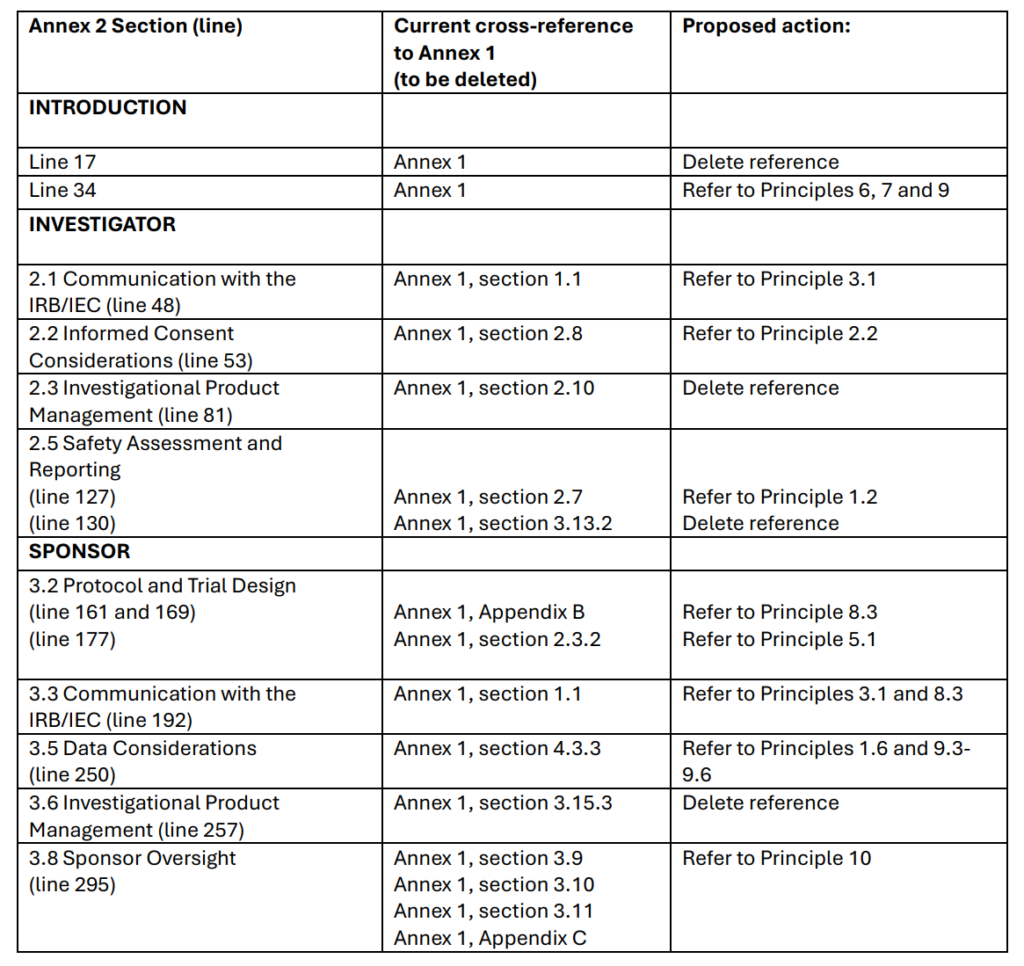
1.2. Replace all references to Annex 1 with references to the relevant Principle(s) (as described in Table 1):
Table 1 – Sections of Annex 2 where Annex 1 is referenced.
2. Flexible assignment of responsibilities
Context: Modern clinical trials often involve contributions from many different individuals and organizations with issues such as data collection, data management, supply and destruction of the investigational medicinal product (IMP), laboratory and imaging services, as well as for enrolment and assessment of trial participants being performed by a range of different parties. The role of sponsor and of investigator may each be performed by multiple organizations. In other trials, including those with regulatory intent, the sponsor and investigator organization may be one and the same (for example in fully decentralised or investigator-initiated trials). There are existing, successful implementations of all these organizational structures and more.
For example:
- some services that might otherwise be delivered by the Investigator may sensibly be delivered by the Sponsor (e.g. central pharmacy and laboratory functions with direct-to-participant services).
- some data may be acquired centrally by the Sponsor (e.g. laboratory data, claims and registry data).
- the investigator may be based at the same organization as the sponsor (this is particularly true for trials conducted by or with academic, healthcare or non-profit organizations, the results of which might be submitted to regulators).
- the sponsor of the trial may be different to the organization submitting for a licensing approval (this is often the case in platform trials, trials conducted by or with academic, healthcare or non-profit organizations).
We are familiar with examples of all of these and many other variations.
Issue: We are concerned that Annex 2 retains an unduly restrictive distinction between the roles of Sponsors and Investigators, which may hinder the implementation of sensible and transparent arrangements that can increase the quality and efficiency of a trial – particularly those that use decentralised or pragmatic elements or make use of RWD.
Specific example – Investigational Medicinal Product (IMP) management
The section on Sponsor responsibilities (section 3 of Annex 2) provides appropriate flexibilities to allow IMP to be supplied to participants via a sponsor-appointed pharmacy. However, section 2.3 of Annex 2 puts the onus on the Investigator to document receipt, use and return of the investigational product, etc. The current reference to section 2.10 of Annex 1 (Investigational Product Management) is particularly unhelpful. It directs the user to a set of statements including that “Responsibility for investigational product(s) accountability rests with the investigator/institution”.
In this example, it would be unreasonable, unworkable and inefficient to require the Investigator to assume responsibility for oversight of IMP accountability. Instead, in such circumstances, it would be more appropriate for the Sponsor to maintain records of direct-to-participant pharmacy services (e.g. postal or local), either directly or through selection and oversight of a third-party.
This suggested approach is in line with established practice in routine clinical care, where physicians may prescribe medicines that are then fulfilled by a local or online pharmacy, neither of which are under any control or form of contract with the physician or physician’s institution but have a legal and professional obligation to only dispense medicines in line with the prescription.
Solution:
2.1 Enhance the Introduction to Annex 2 to clarify that Sponsor and Investigator roles and responsibilities may be assigned flexibly provided that this is documented and agreed by relevant parties in advance.
Following the existing text “Annex 2 is not meant to be comprehensive of all the design elements since clinical trial ecosystems may continue to evolve, and the operational approaches and data sources utilised may expand” (lines 12-14) add:
“For example, in some trials the roles of Sponsor may be covered/divided across multiple organizations or responsibilities for certain data collection or logistical tasks may be undertaken by the Sponsor or a third-party organization, and in some trials the role of Sponsor and Investigator may be performed by the same organization. These and other alternative ways to assign the Sponsor and Investigator responsibilities are permissible as needed to best meet the Principles of GCP, ensure the reliability of the trial results and maintain the safety, rights and well-being of participants. In such cases the full range of roles must be covered and responsibility for each should be clearly documented and agreed by the relevant parties. Where such documentation does not exist or is unclear, responsibility will be assumed to fall to the organization described in ICH E6 (R3).”
2.2 The definitions of Sponsor and of Investigator-Sponsor should be updated to reflect current reality in many trials (and enable sensible alternative approaches in the future) and to mitigate the risk of restrictive interpretations of sponsor and investigator responsibilities.
[Note: The definitions are not included in Annex 2 but are included in the Glossary section of the ICH GCP Principles and Annex 1 document. We presume that those definitions are intended to apply to the entire content of E6 (R3) including all Annexes.]
2.2.a. “Sponsor:
An individual, company, institution or organization that takes responsibility for the initiation, management and arrangement of the financing of a clinical trial. This is not necessarily the company or organization that manufactures, holds the intellectual property rights, or provides the investigational product and it is not necessarily a biopharmaceutical company. A clinical trial may have one or several sponsors…”
[Rationale: Important to correct a common confusion. In particular, many trials have non-commercial sponsors or involve investigational products supplied by several different companies.]
2.2.b “Sponsor-Investigator:
An individual or organization who both initiates and conducts, alone or with others, a clinical trial, and under whose immediate direction the investigational product is administered to, dispensed to or used by a participant. [Delete: The term does not include any person other than an individual (e.g., the term does not include a corporation or an agency).] The obligations of a sponsor-investigator include both those of a sponsor and those of an investigator.”
[Rationale: Elsewhere in the guidance (and in Annex 1) it is acknowledged that Investigator and Institution responsibilities are the same. Many trials are sponsored by non-commercial organizations (e.g. a university or hospital) but still have registrational intent. Of particular relevance to Annex 2, some trials that are decentralised in part or entirely will involve a single organization such as a university or hospital acting as both Sponsor and Investigator (institution) with a large number of participants being enrolled and managed. Even for more conventional trials of the kind envisaged in Annex 1, an organization (e.g. university/hospital) may act as both Sponsor and Investigator institution whilst also involving other investigator sites.]
Additional recommendations
3. Engagement with patient communities (section 3.1.1)
Issue: The inclusion of text to promote engaging patients, patient advocacy groups and their communities in Section 3.1.1 (lines 137 to 144) is noted. However, the text falls substantially short of reflecting established best practice in clinical trials by describing an unduly limited set of potential areas for involvement and consultation.
Solution:
3.1 The text in Section 3.1.1 should be revised to incorporate the relevant principle from the World Health Organization’s Guidance for Best Practices for Clinical Trials, as follows:
“Patients, patient advocacy groups and their communities provide valuable contributions to the design, execution and interpretation of the results of clinical trials. Their early involvement can play a key role in: defining, refining and prioritizing research questions; assessing and increasing the acceptability and feasibility of the trial, selecting trial interventions and outcomes that are relevant and meaningful to the intended population; developing the trial design and procedures; optimizing the nature and delivery of information; and encouraging dialogue about access to health care interventions that prove effective. This activity is particularly important in trials that incorporate decentralised elements, pragmatic elements and/or RWD, where particular skills requirements, technologies or practical considerations may only be identified through such engagement.”
4. Involvement of healthcare professionals (section 2.4)
Issue: In section ‘2.4 Investigator Oversight’, it is helpful to have guidelines on appropriate involvement of healthcare professionals. Lines 121 to 125 are useful in emphasising proportionality and a focus on participant safety and reliability of results.
However, we are concerned that lines 112 to 115 will be overinterpreted. This paragraph suggests that “if knowledge about the protocol, investigator’s brochure or other trial-related document is necessary to perform a trial-related activity”, then delegation, oversight and training are required.
While the text does add some nuance and qualification (e.g. “if needed”), we believe that it should be clearer that for many activities little if any knowledge of the protocol is required and thus oversight, delegation and training obligations for those should likewise be minimal or none.
For example, phlebotomists may be required to do an additional blood draw or take an extra tube of blood, or a radiographer may be required to send a copy of the x-ray to a particular person for reporting/filing. Requiring delegation of duties logs for that is disproportionate, burdensome, and will require extensive monitoring, review and updating for no gain in participant safety or data reliability.
Solution:
4.1 Lines 112 to 115 should be edited to read:
“If substantial or detailed knowledge about the protocol… is necessary…”
4.2 Lines 116 to 120 should be adapted as follows:
“For trial-related activities conducted in clinical practice by healthcare professionals which do not require knowledge about the protocol, investigators’ brochure, or other trial-related documents or where activities are within Usual Care Competence, appropriate arrangements and appropriate investigator oversight should be in place. Such arrangements should address plans for making relevant information and records available to the investigator.”
4.3 Add a definition of “Within Usual Care Competence” as follows:
“Within Usual Care Competence: An activity that an organization or individual is competent to undertake (through current staff experience/training and facilities), but the activity would not happen in quite the same way and/or at the same point in the care pathway if the research study was not taking place.”
[Note: This is based on the UK Health Research Authority definition of Usual Care Competence.]
5. Use of Third Party RWD sources (Section 3.5.1(c))
Issue: Section 3.5.1(c) (lines 233 to 238) states:
“The RWD used in a clinical trial (e.g., data acquired during clinical practice, RWD from a third party) may be owned or controlled by entities other than the sponsor. In such cases, the sponsor should have agreements with those entities in place that allow regulatory authorities to access the source records and data for the purpose of conducting regulatory inspections in accordance with applicable regulatory requirements.”
It is reasonable to require the sponsor should ensure that a certified copy of the data as provided by the RWD system is kept available and unmodified so that the source can be reviewed by inspectors. However, sponsors are unlikely to be able to insist on provision of an auditing right on those who provide RWD (e.g. the NHS in the UK, US Medicare, a hospital EHR provider, a national death register). This is likely to be particularly problematic if the source of information is sensitive for additional reasons (e.g. a health system providing care for current or former military or government personnel) or if the regulatory inspector is from a different country.
The current language could have a detrimental impact on the reliability of the trial results and the ability to assess the safety and efficacy of medicines. For example, there may be a circumstance where information about a patient (such as their date and cause of death) is known in one system (e.g. the records for a hospital that is not enrolling participants in the trial) but is not used for the trial because the sponsor chooses not to link to that source because they cannot secure the necessary audit rights.
If RWD can only be used where source records and data are made routinely available for inspection, it will likely severely limit the range of RWD sources that are available for trials and reduce appetite for their use when they are available due to perception of increased regulatory compliance risk.
Solution:
5.1 Amend the current text to reflect a more pragmatic requirement, as follows:
“The RWD used in a clinical trial (e.g., data acquired during clinical practice, RWD from a third party) may be owned or controlled by entities other than the sponsor. In such cases, an unmodified, certified copy of the data as provided by the RWD system should be available for the purpose of conducting regulatory inspections in accordance with applicable regulatory requirements.”
[Note: Similar language to that we propose here is already included in FDA Guidance on the Use of Real-world evidence to support regulatory decision-making for medical devices.]
6. Focussed safety assessment and reporting (section 3.9.1)
Issue: The current text relating to safety assessment and reporting in 3.9.1 (particularly lines 300 to 304) may exacerbate the issue of excessive uninformative communication of safety information. Requiring that the sponsor “should ensure that safety information is appropriately captured and made accessible to the investigator in a timely manner” fails to distinguish between the need to capture data that can inform an overall assessment of the safety of the intervention and information that is relevant to the immediate clinical management of participants under the investigators’ care.
The risk of important safety information being missed increases when the investigator is overwhelmed with unfiltered safety reports from all sources of information – as the current text may encourage – which can dilute the ratio of relevant, actionable information that requires timely response to the ‘noise’ of routine safety data that may require randomized comparison to assess causality.
6.1 Solution:
Amend the text on line 301 so that the sentence reads:
“The sponsor should ensure that safety information is appropriately captured and that the investigator is made aware of information that is relevant to the safety of their participants in a timely manner according to the protocol.”
Administrative Comments
7. Timely regulatory advice (Section 3.1.3)
Issue: The encouragement on lines 154-156 “to engage with regulatory authorities early, especially when designing and planning trials that use various operational approaches… and RWD sources” appears not to account for constraints on regulators’ capacity to meet expectations for advice, either in relation to timeliness, resources or expertise. While constructive, timely dialogue with regulators is desirable, the current wording may risk generating demand that exceeds capacity and may also lead to a perception of increased risk or cost associated with decentralised/pragmatic elements or use of RWD sources. Some regulators who provide such scientific advice are already over-subscribed and have long turn-around times.
Such guidance may also have adverse consequences such as creating:
- Perception of additional risk
- Unreasonable additional cost
- Substantial additional delays
- Increasingly conservative approaches to avoid the above.
For example, Sponsors may avoid sensible design choices (e.g. use of decentralised elements or use of RWD) if they believe that they would then necessitate lengthy or costly delays waiting for regulatory feedback.
Solution:
7.1 Edit section 3.1.3 to read:
“Sponsors are encouraged to may engage with regulatory authorities early, especially when designing and planning trials that use various operational approaches (including complex design elements and technological tools) and RWD sources. Early engagement will may help address the appropriateness of using such operational approaches and RWD sources in the design of their trial and will allow for timely identification of challenges and strategies for resolution.”
8. Extend public consultation period
Issue: We note the publication of the finalised, updated ICH GCP Principles and Annex 1 on 14 January 2025. In most jurisdictions, this allows only six weeks (until 28 February 2025) to consider the draft Annex 2 in the context of the related final documents before the deadline for providing public comments. In Japan and China, it is 11 and 13 days respectively. We believe this timeframe is insufficient to support a robust and inclusive consultation process and risks missing opportunities to make important improvements or correct significant issues and errors.
A longer consultation period would not only enhance the quality of stakeholder input but also build confidence in the ICH’s commitment to transparency and collaboration. Ultimately, this approach would contribute to a more effective and widely accepted framework that aligns with the principles of Good Clinical Practice and supports global harmonisation efforts
Solution:
8.1 Extend the timeframe for accepting public comments.